


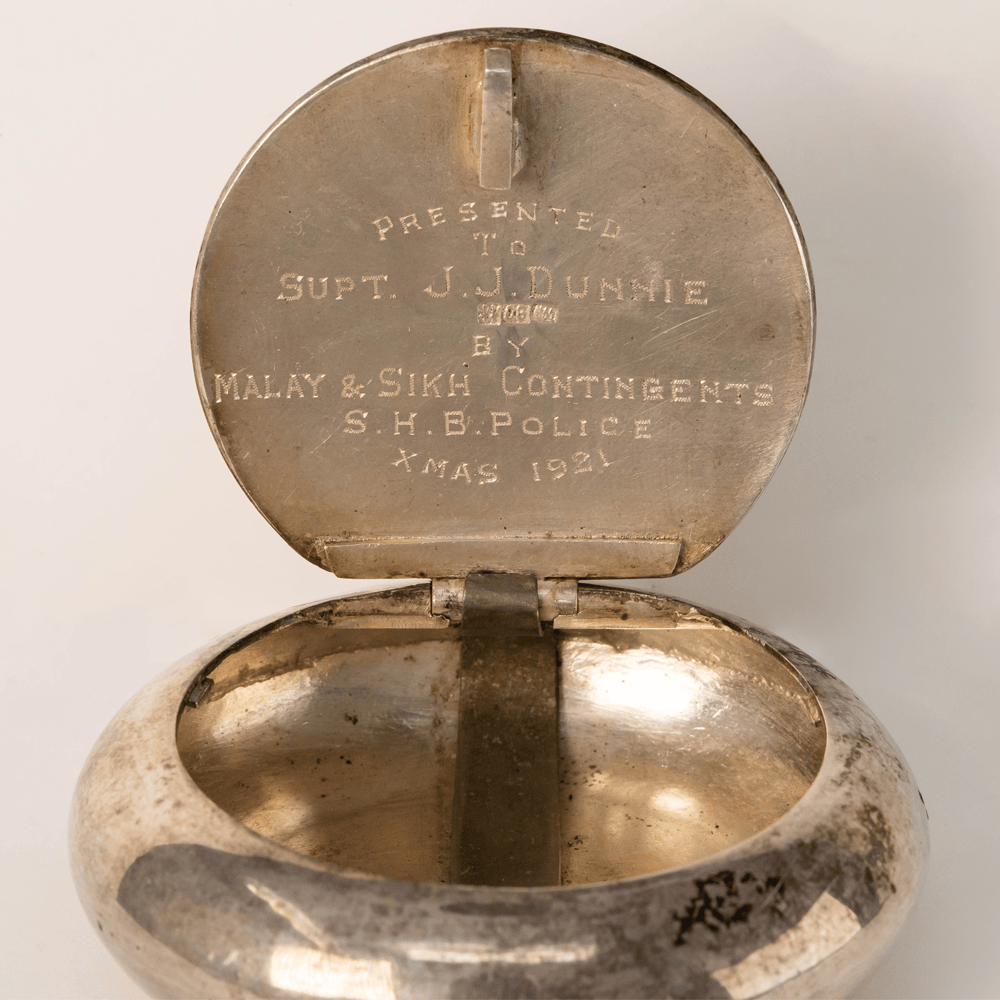
1921 Shanghai Harbor Board Police Presentation Silver Tin — Sikh & Malay Contingents, Dragon Motif
Few objects this small contain this much history. This silver tin — just 2 7/8" across, decorated with a finely detailed dragon motif on its lid — bears an inscription that opens a window onto one of the most extraordinary chapters of 20th century urban history: treaty-port Shanghai at the height of its cosmopolitan power. The inscription reads: "Presented to Supt. J.J. Dunnie by Malay & Sikh Contingents S.H.B. Police, Xmas 1921." That single sentence connects this object to the Sikh and Malay Contingents of the Shanghai Harbor Board Police — men who served under a British superintendent in one of the most complex, charged, and historically significant cities on earth.
What the inscription tells us
The S.H.B. — Shanghai Harbor Board — maintained its own police force to protect Shanghai's docks, wharves, and port operations, separate from the larger Shanghai Municipal Police that governed the International Settlement. Like its counterpart, the Harbor Board Police drew on the British colonial tradition of employing Sikh and Malay officers — men recruited across the British-administered territories of Asia whose loyalty and discipline were considered exemplary by their commanders. This presentation tin was a Christmas gift from those men to their superintendent, J.J. Dunnie — a gesture of goodwill and respect that crossed lines of culture, religion, and empire. The dragon motif on the lid — quintessentially Chinese, almost certainly the work of a Shanghai silversmith — makes the object itself a perfect symbol of the collision of cultures that defined 1920s Shanghai: a Chinese-made silver piece, presented by Indian Sikh and Malay officers, to a British police superintendent, in a harbor city that belonged to no single empire yet bore the mark of all of them.
In 1921, Shanghai was arguably the most cosmopolitan city in the world. The International Settlement and the French Concession operated as effectively autonomous zones under foreign administration within a Chinese city, governed by council, policed by a force that included British, Chinese, Sikh, Malay, Japanese, and Russian officers — each contingent with its own chain of command, uniform, and cultural identity. Sikh policemen were an indelible part of the landscape of Shanghai in the first decades of the twentieth century and have left their mark in the ways in which the city is remembered up to the present day — their distinctive red turbans becoming one of the defining visual signatures of the city's treaty port era. The Malay contingents served alongside them in harbor and port policing roles, forming a tight-knit professional community far from their homes in British Malaya.