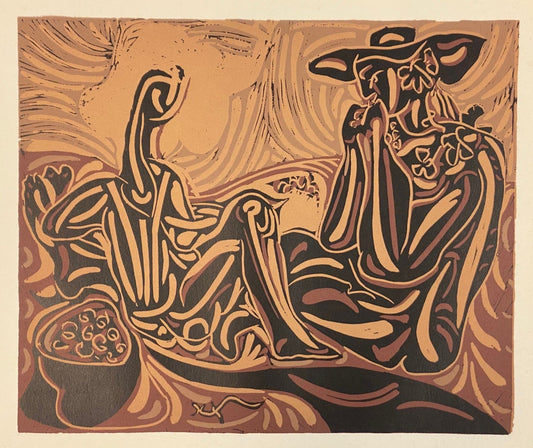
Picasso: The 1962 Linogravures of Vallauris
Between 1958 and 1963, Pablo Picasso revolutionized the medium of printmaking from his home in southern France. Distanced from his usual printers in Paris, he collaborated with local printer Hidalgo Arnéra to master the linocut. Picasso’s genius led to the development of the "reduction" technique, where he carved and printed from a single block of linoleum multiple times to layer colors. This high-stakes process effectively destroyed the original block during creation, meaning the master images could never be struck again. These works, characterized by their vibrant Mediterranean ochres, bold bullfighting motifs, and intimate portraits of his wife Jacqueline, represent one of the final and most joyful technical triumphs of his long career.
These individual plates offer a rare opportunity to own an authorized "after" from the definitive 1962 first edition. Created in a historic collaboration between Picasso, Galerie Louise Leiris and publisher Éditions Cercle d’Art, these plates were meticulously produced to serve as high-fidelity lithography after the original signed editions. Printed in Stuttgart with exceptional attention to color accuracy and embossed texture, they were intended to bring Picasso's masterworks to a wider circle of collectors while maintaining the artist's rigorous standards. Today, these first-edition plates are highly sought after by collectors worldwide as authentic artifacts of Picasso’s mid-century legacy.