


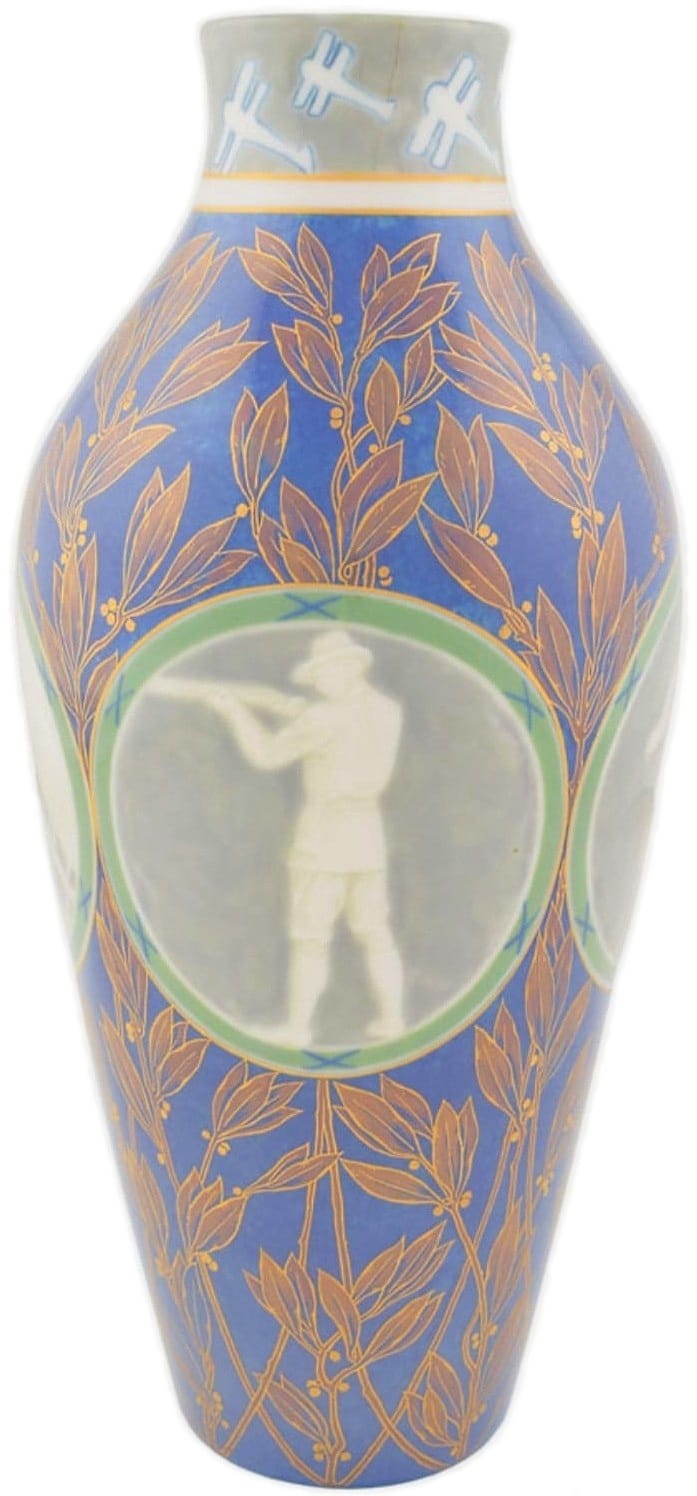
1924 Paris Olympics Gold Medal Winner's Sèvres Porcelain Vase
This is one of the rarest and most extraordinary Olympic artifacts in existence — an original 1924 Paris Olympics gold medal winner's vase produced at the world-famous Sèvres Porcelain Manufactory, designed by celebrated French artist M.O. Guillonet and executed by Émile Bracquemond. Standing 13 inches tall and 5.5 inches at its widest point, this magnificent piece of French decorative art was presented by the Paris City Council to the gold medal winners of the VIII Olympiad and is one of only 309 ever produced.
The Sèvres vase was only awarded to gold medalists at the 1924 Paris Olympics. After 1924, the rules were changed and winners received only medals, making these surviving examples extremely rare pieces of Olmypic sports history.
Sèvres — the most prestigious porcelain factory in the world
The Manufacture Nationale de Sèvres was established by King Louis XV in the mid-18th century and has operated continuously as France's national porcelain manufactory ever since — producing pieces for French royalty, heads of state, and the world's greatest decorative art collections for nearly 300 years. A Sèvres vase is not merely a decorative object — it is one of the most prestigious art objects a person can own, and recipients throughout history have treated them as treasures. The 1924 Olympic vases were designed by Octave Denis Victor Guillonet, a celebrated Orientalist painter and founding member of the Society of Sport Painters and Sculptors and executed by Émile Bracquemond at the Sèvres factory. Each vase features hand-painted golden laurel branches on a deep French blue background, with four pâte-sur-pâte medallions depicting Olympic sports in white relief on gray oval grounds with green borders. The base bears the appropriate Sèvres maker's marks and the date 1924.
The VIII Olympiad, held in Paris in the summer of 1924, is one of the most celebrated and romanticized chapters in the history of the Olympic Games — immortalized in the Academy Award-winning film Chariots of Fire (1981), which dramatized the stories of British sprinters Harold Abrahams and Eric Liddell. The 1924 Games saw 44 nations and over 3,000 athletes compete across 126 events, producing performances that defined the era: Johnny Weissmuller — later famous as Tarzan — won three swimming gold medals; Finnish distance runner Paavo Nurmi won five gold medals in six days; Uruguay's football team made their stunning debut on the world stage, winning gold and launching one of the great dynasties in international football history. The 1924 Games were also the first at which the Olympic motto Citius, Altius, Fortius — Faster, Higher, Stronger — was officially adopted. A vase from these Games is not just a piece of Olympic history. It is a piece of the history of sport itself.
| Year | 1924 |
| Event | VIII Olympiad — Paris Summer Olympics · Gold Medal Winner's Prize |
| Designer | M.O. Guillonet (Octave Denis Victor Guillonet, 1872–1967) |
| Executed by | Émile Bracquemond at the Manufacture Nationale de Sèvres |
| Material | Sèvres pâte-sur-pâte porcelain · hand-painted golden laurel branches on French blue ground |
| Dimensions | 13" tall x 5.5" wide |
| Total produced | 309 — awarded exclusively to individual gold medalists and team captains |
| Marks | Sèvres maker's marks and date 1924 to base · "Décoré à Sèvres 1924" |
1924 Paris Olympics Sèvres Vase — Quick Facts
- Only 309 of these vases were produced in total — one of the most restricted editions in the history of Olympic artifacts — awarded exclusively to individual gold medalists and the captains of gold-medal winning teams at the 1924 Paris Games
- This was the only Olympics in history to award a Sèvres trophy vase; Pierre de Coubertin opposed the idea but the project proceeded for 1924, after which the rules were changed and only medals were awarded at all subsequent Games
- The Manufacture Nationale de Sèvres was established by King Louis XV in the mid-18th century and remains one of the world's most prestigious porcelain manufacturers — a Sèvres piece is among the most coveted objects in French decorative art
- M.O. Guillonet (1872–1967) was a celebrated Orientalist painter, sports artist, and founding member of the Society of Sport Painters and Sculptors — a fitting choice to design the trophy vase for the greatest sporting event in the world
- Gold medal winners at the 1924 Paris Olympics who received this vase included Johnny Weissmuller (swimming), Paavo Nurmi (distance running), Andrew 'Boy' Charlton (swimming), and members of Uruguay's legendary gold medal football team — the games immortalized in the film Chariots of Fire
- The 1924 Paris Games were the first Olympics to officially adopt the motto Citius, Altius, Fortius — Faster, Higher, Stronger — the same words that define the Olympic movement to this day
- When an example of this vase awarded to legendary jazz musician Louis Armstrong was discovered, he had kept it prominently displayed in his living room — a testament to the esteem in which recipients held these extraordinary objects